Contact Us


Respond at Machine Speed
Power the Agentic SOC
Winning in the AI era requires understanding what activity means in real time across your environment—from legacy systems and cloud infrastructure to AI workloads, privileged identities, and critical assets.
ExtraHop transforms network telemetry—the most reliable source of truth—into structured, real-time context for machine reasoning. The result: security automation that operates at machine speed with the accuracy and defensibility enterprises require.


Challenges
The Modern SOC Was Never Designed For AI-Powered Attack Velocity
AI is fundamentally changing the speed, scale, and adaptability of cyberattacks. Breakout time—the window between initial compromise and lateral movement—has collapsed as attackers use AI to automate reconnaissance, adapt in real time, and evade static defenses without human intervention.
Traditional SOC workflows cannot keep pace. Security teams already operate under overwhelming alert volume, forced to triage thousands of signals daily while piecing together fragmented evidence across tools, environments, and identities. To manage the load, analysts suppress low-fidelity detections, aggressively tune alerts, automate closure, or allow queues to age out—introducing blind spots attackers increasingly exploit.
This creates a dangerous asymmetry: attackers now operate at machine speed while defenders still rely on workflows built for human-scale investigation.
Enterprise security has reached a tipping point. The shift to an agentic SOC is no longer optional—it is required to detect, understand, and respond at the speed of modern attacks.
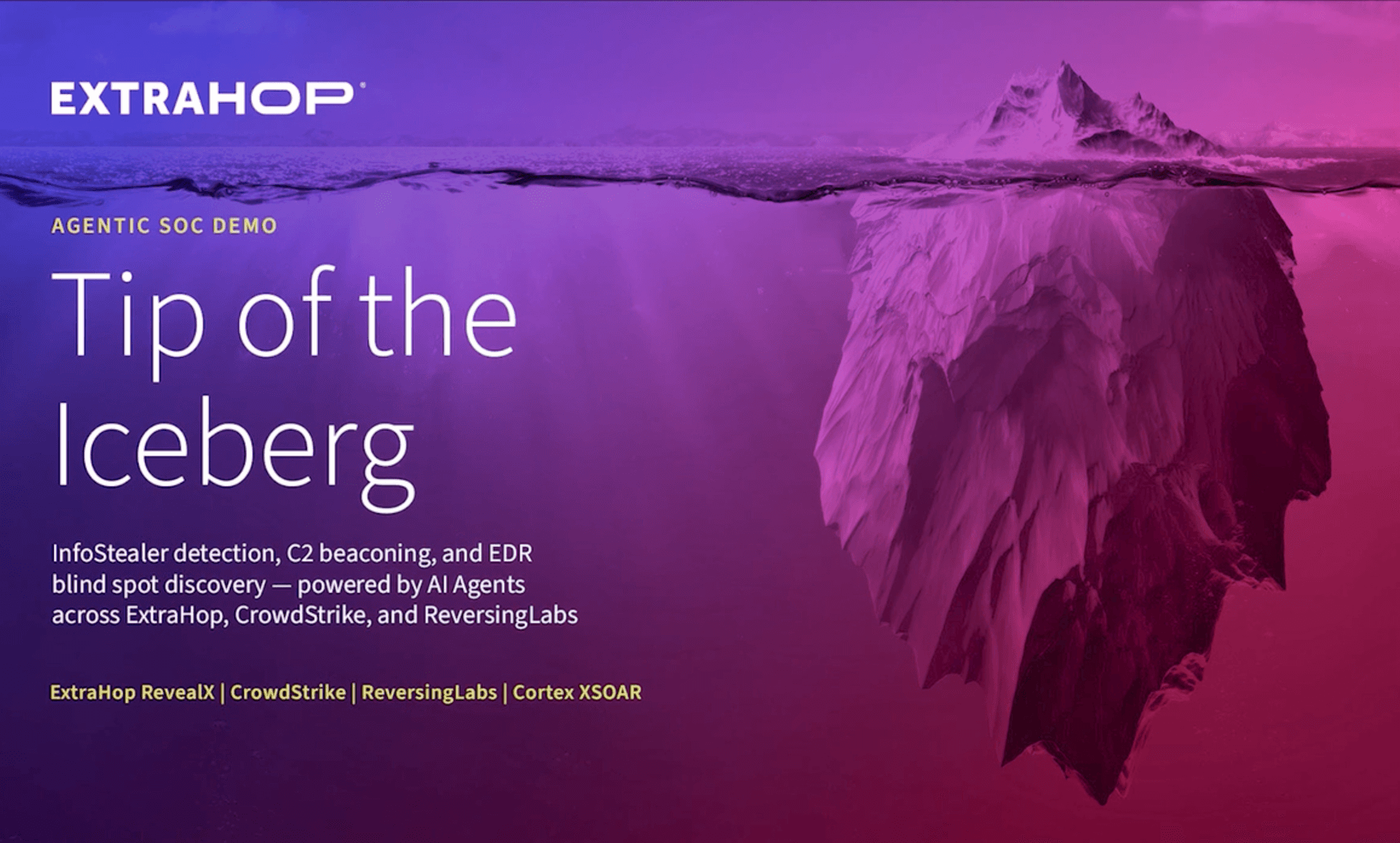
AGENTIC SOC DEMO
Tip of the Iceberg
In this demo, we follow an attack from initial user deception to full agentic SOC response. A user on a Windows 11 workstation is tricked by a fake CAPTCHA into running a malicious PowerShell command. CrowdStrike catches the final payload, but the endpoint alert is only the tip of the iceberg.
 Agentic SOC Demo - Tip of the Iceberg
Efficient Reasoning
Structured Context for Efficient, Affordable Reasoning
Large language models (LLMs) are powerful, but expensive and inefficient when applied directly to raw telemetry, packet captures, and unfiltered logs. Feeding massive volumes of disconnected data into autonomous agents quickly overwhelms token budgets, saturates context windows, and degrades reasoning quality as meaningful signal gets lost in noise.
Autonomous agents require structured context: data that is already enriched, correlated, and optimized for machine reasoning. High-signal context allows models to reason efficiently about relationships, behaviors, and intent—who communicated with whom, over what protocol, in what sequence, how activity deviated from baseline, and whether it requires immediate attention.
When an autonomous triage or response agent encounters a signal, ExtraHop provides immediate, high-fidelity context across the environment. Agents can then drill into packet-level evidence only when a specific hypothesis or investigation requires deeper validation.

Blog
The Data Layer is Becoming the Performance Ceiling for Agentic AI in Security Operations
The bottleneck for the agentic SOC is the quality of the data your agents are asked to reason over. Why the data layer is becoming the limiting factor.
SEE IT IN ACTION
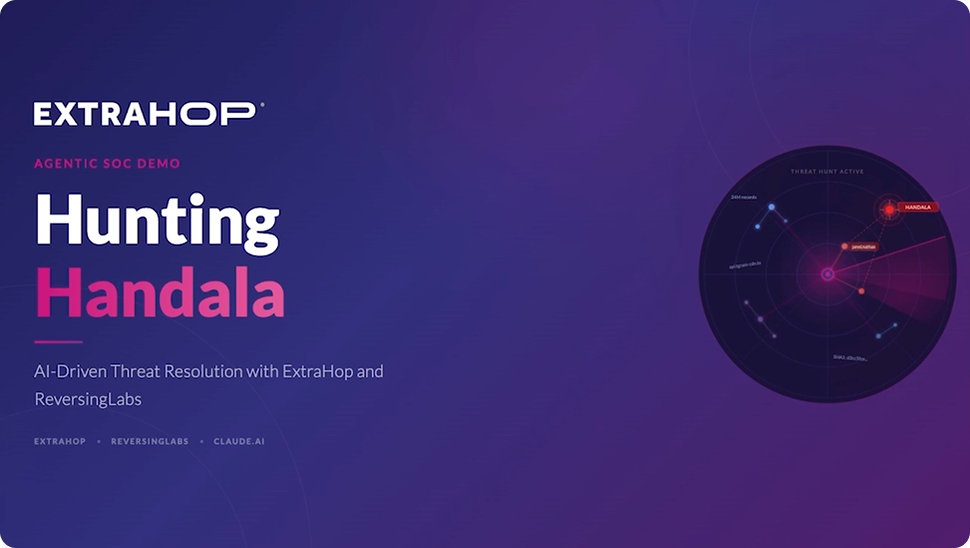
Hunting Handala
In this demo, we are given an FBI warning about the Handala hack team—an Iranian-linked, pro-Palestinian hacktivist group widely considered a front for Iran's Ministry of Intelligence and Security (MOIS). It provides information about a malicious file hash. We then use Claude to find indicators of compromise and suspicious activity, as Claude taps into network context from ExtraHop and threat context from ReversingLabs.
Watch Hunting Handala demo video

Solution
Market-Leading Network Detection and Response
Leverage the network as a source of truth in order to stop cyberattacks. The ExtraHop RevealX platform allows you to get unparalleled visibility and security control across all assets in your organization.
Agentic Tools

GET TOOLS ON GITHUB
Visit the ExtraHop GitHub repository to get agentic tools, guidance on how to deploy, and more.

ALLIANCE
Agentic SOC Alliance
Key market innovators unite to define and standardize the new SOC operating model: a three-layer architecture of Context, Harness, and Model that gives autonomous security agents the evidence, governance, and reasoning they need to act with precision.