ExtraHop named a leader in the Gartner® Magic Quadrant™ for Network Detection and Response

Search
  • Platformchevron right
  • Solutionschevron right
  • Modern NDRchevron right
  • Resourceschevron right
  • Companychevron right

DETECTION OVERVIEW

Impacket DCOMExec Activity

Risk Factors

Impacket is an open-source collection of tools for manipulating packets and network protocols, including the Distributed Component Object Model (DCOM) interface. An authenticated attacker with administrator privileges can run commands with the DCOMExec tool to compromise remote devices, helping the attacker move laterally across the network.

Category

Lateral Movement
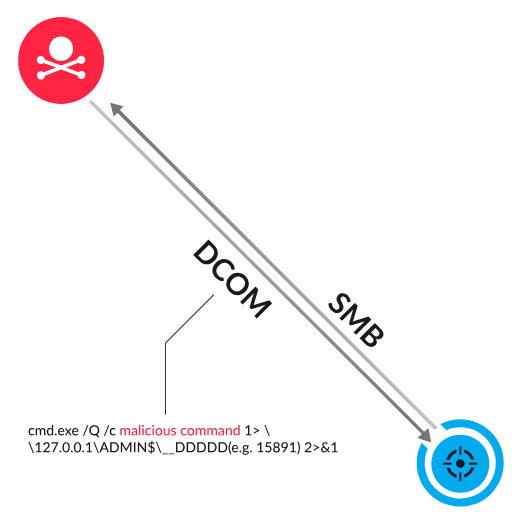
Detection diagram
Next in Lateral Movement: Impacket PsExec Activity

Description

DCOM is a Microsoft protocol that enables applications to interact with Component Object Model (COM) objects on a remote Windows application. COM objects contain methods and properties that perform specific actions, such as running commands or managing files. For example, MMC20.Application is a COM object with an ExecuteShellCommand method that can accept and run commands on a server.

Impacket is a toolset that includes DCOMExec, a Python script that leverages DCOM to launch unauthorized processes that resemble routine administration. The attacker runs dcomexec.py, which sends a DCOM request over MS-RPC to the target device. This request creates a specific COM object, such as MMC20.Application, ShellWindows, or ShellBrowserWindow. DCOMExec sends an MS-RPC request to map the names of methods and properties on the new COM object to an integer value returned by the server that is called a Dispatch Identifier (DISPID). DCOMExec calls the method by sending an Invoke request with the corresponding DISPID and passes a command through the method parameters, which redirects the command output to a temporary file on an SMB file share. The attacker then retrieves and deletes this file remotely to avoid local logging and blend into legitimate network traffic.

Mitigation Options

Disable DCOM

Block or restrict DCOM access to authorized IP addresses in Windows firewall settings

Modify the MMC20.Application, ShellWindows, and ShellBrowserWindows DCOM objects by removing the RemoteActivate and RemoteLaunch permissions from the Local Administrators group

MITRE ATT&CK ID

Associated content

Announcing The Forrester Wave™: Network Analysis And Visibility Solutions, Q4 2025

Network analysis and visibility solutions remain underrepresented in enterprises. Find out why in this preview of a new Wave report.

Blog Post

ExtraHop® Named a Leader in First-Ever Gartner® Magic Quadrant™ for Network Detection and Response — ExtraHop

News

Detections

Visit this resource for more information.

Documentation

The 2025 ExtraHop Global Threat Landscape Report: The Alarming Reality of Threat Actor Dwell Time and Deeper Network Access — ExtraHop

This analysis exposes the critical link between an organization's lack of internal visibility and the escalating cost of compromise, demanding an urgent re-evaluation of how core business assets are protected.

Blog Post

ExtraHop RevealX MITRE ATT&CK Coverage 2024 — ExtraHop

Learn why you need to be wary of the claims certain network detection and response providers make about their coverage against the MITRE ATT&CK framework.

Blog Post

MITRE ATT&CK - Network Detection & Response with RevealX — ExtraHop

Learn how NDR from RevealX helps security teams detect and investigate more adversary TTPs in the MITRE ATT&CK framework than rule-based tools.

Report
Periodic Table of Use Cases

What else can RevealX do for you?