

 Contact Us





Context for the Agentic SOC
AI-Powered Security Operations
Ground AI security decisions in real-time network evidence.
In security operations, speed matters only when decisions are accurate. ExtraHop gives AI agents high-signal, real-time context to investigate faster, reason accurately, and make decisions teams can verify and defend.
Differentiators
Why ExtraHop context is different
AI decisions are only as reliable as their context.
AI agents can accelerate triage, investigation, threat hunting, detection engineering, and response. But they cannot reason around incomplete or stale evidence.
Most security data was built for storage, search, and human review, not for autonomous decisions. Logs arrive late or incomplete. Inventories drift. Alerts isolate events from the entities, sequence, and behavior that make them significant.
ExtraHop continuously observes network activity and organizes it into a current view of assets, identities, relationships, transactions, and behaviors. Agents reason from that context instead of reconstructing it.

NETWORK CONTEXT DEMO
Why Every Agentic Investigation Needs Context
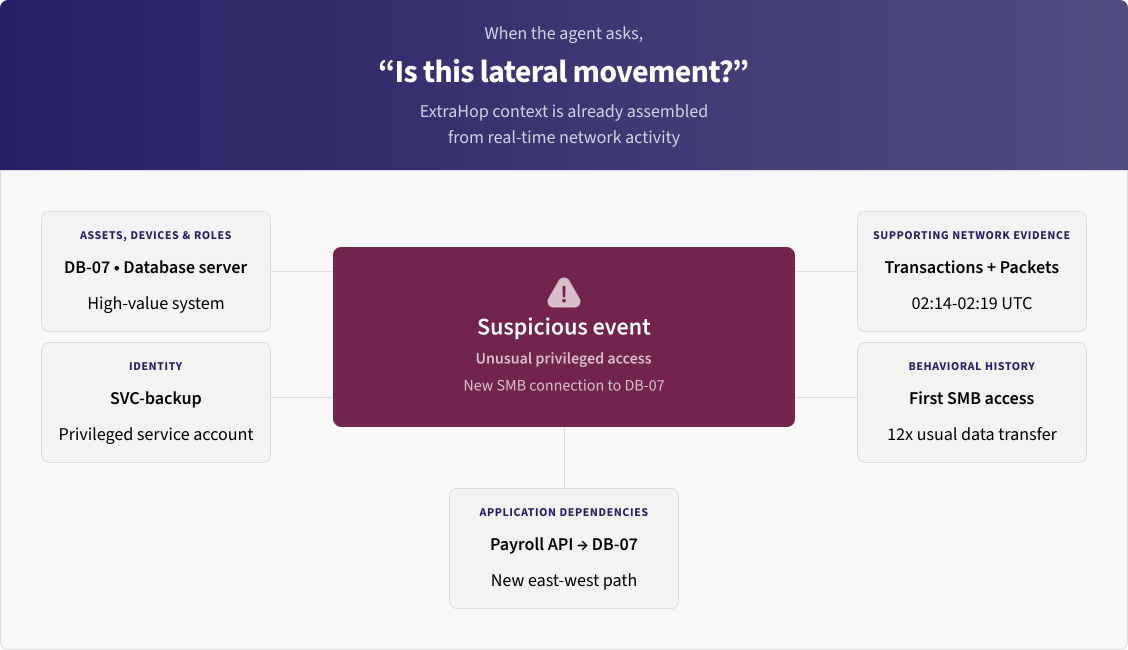
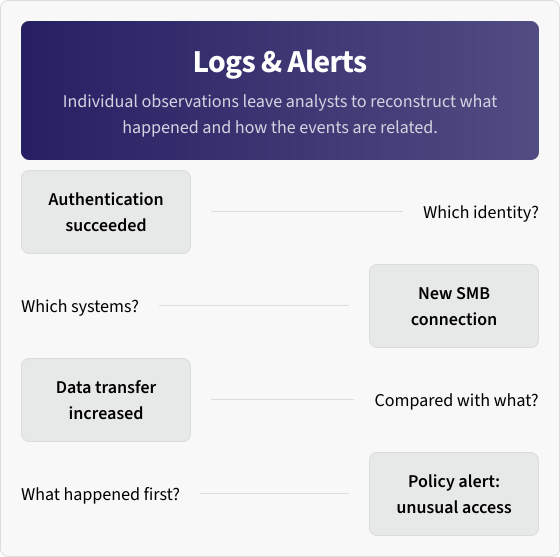
Network behavior reveals what logs and alerts often miss
Logs record what individual systems are configured to report. Alerts identify activity that matches a rule or defined detection.
Network behavior uniquely shows how systems actually interact across the environment, revealing suspicious activity that looks legitimate in isolation, such as a trusted account connecting to a new system, a workload using an unexpected protocol, or an application moving far more data than usual.
These behaviors can indicate credential abuse, lateral movement, or data theft even when no malware or known signature is present.
ExtraHop turns network traffic into structured, high-signal metadata that shows which systems were involved, how they interacted, what happened and when, and whether the activity differed from normal behavior.
It correlates and enriches that metadata with asset, identity, behavioral, and threat context in real time, giving AI agents relevant evidence to reason over instead of volumes of raw, disconnected telemetry.
Build a living map of your environment, and see threats as they move
ExtraHop passively analyzes mirrored network traffic to continuously discover and classify every asset, mapping device types, high-value systems, and the dependencies between them.
Because ExtraHop operates outside the endpoint, it covers OT and legacy systems that cannot run endpoint agents, and keeps watching when EDR is bypassed, disabled, or evaded. As attacks move across the network, ExtraHop correlates behavior across command and control, lateral movement, and data transfer, so analysts and AI agents can trace the attack path and spot what else is at risk.
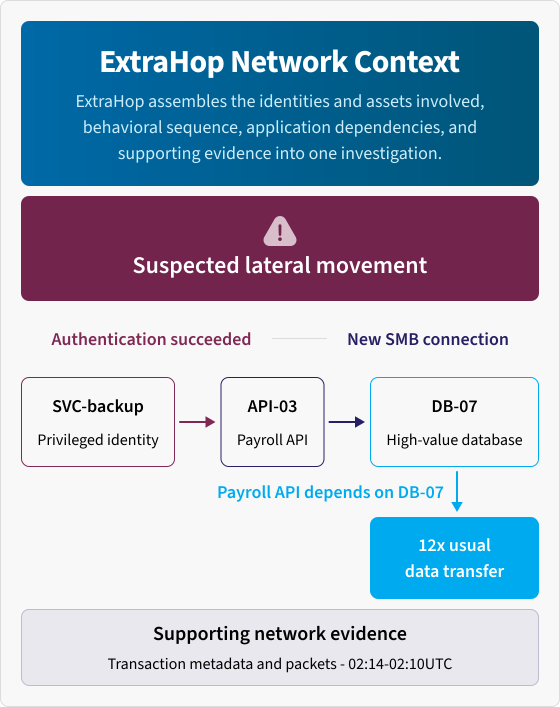
Know what changed and if it matters
ExtraHop continuously compares current activity with behavioral and peer-group baselines to identify changes in the amount of data transferred, communication frequency, sequence of activity, destinations, protocols, and access patterns. It correlates those changes with asset criticality, identity, system relationships, and threat intelligence.
Why ExtraHop context is high-signal:
AI agents receive a connected view of what happened, which assets and identities were involved, why it matters, and where to find supporting evidence. Instead of reconstructing the full picture from raw, disconnected telemetry, agents can begin with decision-relevant context and retrieve deeper evidence as needed.
COST & EFFICIENCY
How tiered context improves efficiency and token use
Use fewer tokens without sacrificing evidence.
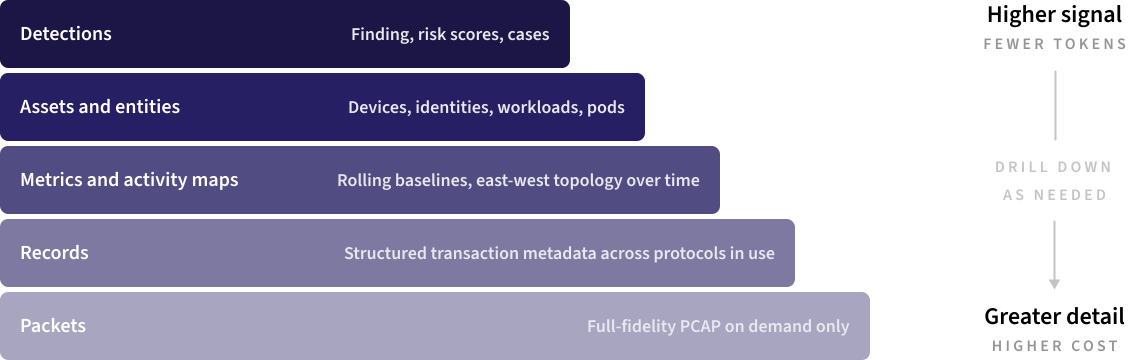
Feeding volumes of raw logs and packet-derived data into a large language model is costly and can bury the relevant signal. Standalone summaries reduce token use by discarding detail, which can leave agents without the evidence needed to verify a conclusion.
Instead, ExtraHop keeps concise, high-signal context connected to the underlying transaction metadata and packets, allowing agents to retrieve deeper evidence on demand.
Agents begin with the highest-signal context that can answer the question, and drill down only when the investigation requires more detailed evidence.
DEFENSIBLE RESULTS
Why the result is defensible
Trace every decision to evidence and verify every outcome.
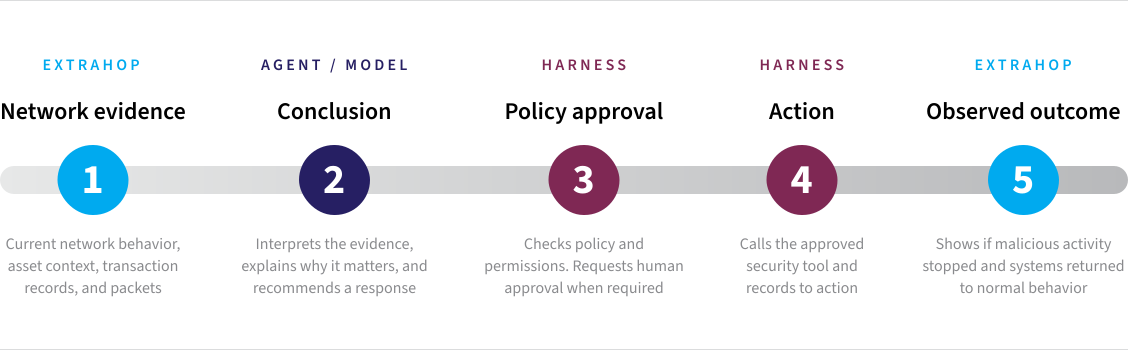
A production-ready agentic SOC must show what an agent saw, why it reached a conclusion, which action was authorized, and whether that action produced the intended result. Under DORA, a financial entity has four hours from classification to report a major ICT incident; under NIS2, 24 hours for an early warning. Neither regime cares whether a person or an agent reached the conclusion, and both require you to show how it was reached.
ExtraHop maintains the network evidence behind an investigation so an agent's conclusion can be reconstructed and reviewed. Investigators can move from a finding to the related entities, transaction metadata, and packets.
Move from pilot to production without losing control.
Moving into production requires control over what agents can access, which actions they can take, when human approval is required, and how each step is recorded.
The harness maintains policies, approvals, tool-call history, and action logs. ExtraHop supplies the network evidence behind the conclusion and validates the observed result after an action.
Together, they create an auditable chain from evidence and conclusion to authorized action and observed outcome. This gives security teams the accountability and control required for a predictable, fully governed, production-ready SOC.
Give your AI SOC better evidence
See how RevealX turns network activity into high-signal context for accurate, efficient, and defensible security operations.


