Reduce Breach Risk
Decrypt the traffic others miss, reveal hidden attack surfaces, and stop intrusions before impact.
Respond at Machine Speed
Arm SOC and NOC agents with structured, real-time ground truth to investigate and act decisively, in seconds.
Accelerate AI Adoption
Expose shadow AI, infrastructure strain, and runaway costs the moment they hit the network.
Solutions by Industry
Investigate smarter and stop threats faster—ExtraHop helps enterprise organizations across every industry.
CUSTOMER STORY
How do you provide a seamless customer experience across the company's online and physical operations?
Press Release
The modern NDR platform built for federal agencies
Consolidate your NDR, NPM, and IDS tools into a single platform that delivers a holistic view of all network activity
From streamlined analytics to response automation, together, we help you thrive.
Industry coalition defining the open operating model for autonomous security operations.
Report
See why ExtraHop is a leader in the 2026 Gartner® Magic Quadrant™ for Network Detection & Response

EBOOK
High-fidelity telemetry for autonomous decision-making.
Company
Media
Partners
ExtraHop® Closes Enterprise Data Center Blind Spots with the First NDR Platform to Run at 400 Gbps
Solutions
Industries
Home Depot and RevealX™ Build a Better Customer Experience
ExtraHop Achieves FedRAMP® Authorization
Platform
Gartner® Magic Quadrant™ 2026
Resources
The Agentic SOC Blueprint
Customers
Machine-Speed Threats. Machine-Speed Defense. Now at 400 Gbps
Decryption enhanced
Detection Supported
A brute force attack is a trial-and-error attack method to guess a password, encryption key, or hidden webpage. See brute force attack examples.
What is a supply chain attack? Types of supply chain attacks, history of attacks, and effective methods to protect enterprise organizations.
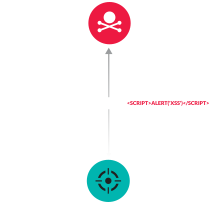
Learn about cross-site scripting (XSS) attacks and the top three ways to prevent an attack. See risk factors and examples.
Detection Reported
Learn how to detect C2 beaconing. C2 beaconing is a method of command and control communication between malware-infected hosts (like those that make up botnets) and the controlling server.
Cryptomining malware, or 'cryptojacking,' is a malware attack that co-opts the target's computing resources in order to mine cryptocurrencies like bitcoin.
HTTP request smuggling attack takes advantage of inconsistencies in how servers process requests from multiple senders. Learn more and see examples.
What is Malware Obfuscation? See techniques, history of attacks, and effective detection methods.
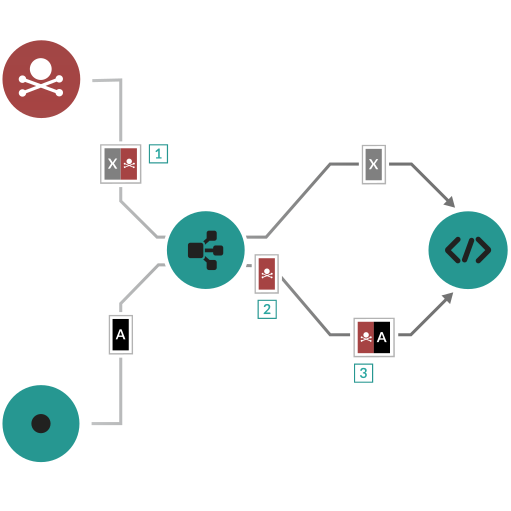
A DCSync attack uses commands in MS-DRSR to pretend to be a domain controller (DC) in order to get user credentials. Learn more and see examples of attacks.
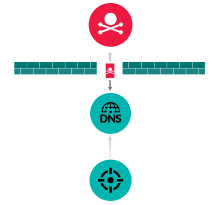
DNS tunneling routes DNS requests to the attacker's server, providing attackers a covert command and control channel. Learn more and see DNS tunneling examples.
Denial of service (DoS) & distributed denial of service (DDoS) attacks overload a machine or network to make it unavailable. Learn how to respond to an attack.
Port scanning attackers scope out their target environment by sending packets to specific ports on a host and using the responses to find vulnerabilities.
Ransomware is a type of malicious software which encrypts files, making them inaccessible until a ransom is paid. Learn more and see examples.
What are RCE Attacks and Vulnerabilities? See attack examples, history of attacks, and effective methods to protect enterprise organizations.
Attacks like RDP exploitation hijack remote access tools to access a network's internal systems. Learn more and see examples.
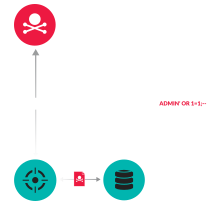
By injecting an SQL command into a data entry field, attackers communicate directly with your database. Learn more and see examples such as RDP exploitation.